

How Do Workers View Mental Health Risks in the Workplace?
This post is part one of a two part series in which I share some of my dissertation[1] research. In it, I takes a look at demographics and their role as predictors of perceived psychosocial risk. The second part, Workplace Culture in the Canadian Construction + Extractive Industries takes a look at unwanted sexual attention and bullying.
For the past few years, I’ve been studying psychosocial risk management to try and understand more about different risks and how they impact people and organizations. Through my research I found that the voice of the worker was largely absent in discussions about risk. So, I focused my dissertation research on collecting workers’ views to see if there was any connection between demographics and workers’ experiences with psychosocial risk. If you’re a real keener, you can read my full dissertation[1] but for the other 99% of you, I’ll be sharing some of my findings here, in the EQ Blog.
Who Participated?
Data was collected from 249 participants using an online survey. Participants were required to be actively or recently working in the Canadian construction or extractive industries, 18 years or older and have site-based work as part of their job requirement. A total of 174 records were completed in full and used for the analysis. A brief breakdown of demographics:
- Gender: female (36%); male (64%)
- Age: 18-30 (6%); 31-45 (49%); over 45 (45%)
- Employer: project owner (50%); prime contractor (20%); subcontractor (30%)
What Was Studied?
I looked at five different demographic traits: age, gender, employer type, living arrangement, and rotation status. Using these traits, I analyzed their relationship to a set of psychosocial risk factors.
What Did We Learn?
The study found numerous significant relationships between demographics and experiences of psychosocial risk—too many to cover here. Instead, I’m going to focus on a few of the findings related to age, gender, and employer type because they were the most prominent factors in the study.
One of the most important findings was that on their own, neither age nor gender (or the other demographic factors) were enough to fully explain differences in workers’ experiences. What this means practically is that any assumption of what a worker might experience just because they are young, old, male, or female is false.
Another finding was that who a worker is employed by is an important aspect of their experience. Those working for project or operation owners often had a different experience than those employed by prime contractors. This finding is especially interesting given that these two groups often work in parallel and in close proximity to one another.
Time + Task Demands
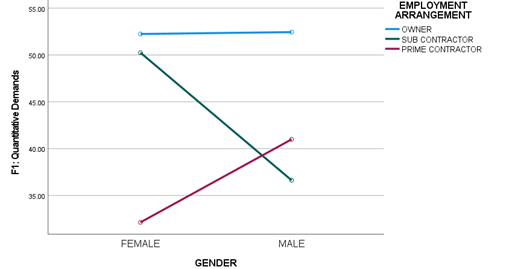
When it came to time and task pressures (quantitative demands), who you work for played an important role for younger workers and women. Younger workers (18-30 years) employed by subcontractors or prime contractors had the lowest levels of pressure, but those working for owners reported nearly 3x the level of pressure. Similarly, women working for owners reported nearly 2x more pressure as those employed by prime contractors.
Possibility for Development
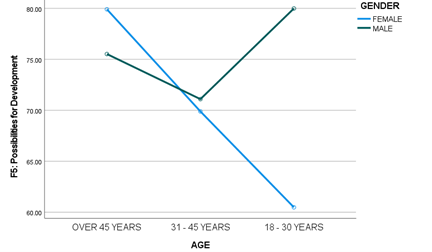
Gender and age were important factors when it came to development opportunity. The highest scores were reported by male workers, especially those who lived in their own accommodation (self-provided) or worked for an owner. Younger workers, especially younger female workers, viewed their opportunities as low. Other than female workers employed by prime contractors, subcontractors (both male and female) reported lower scores of development opportunity.
Meaning of Work + Work Commitment
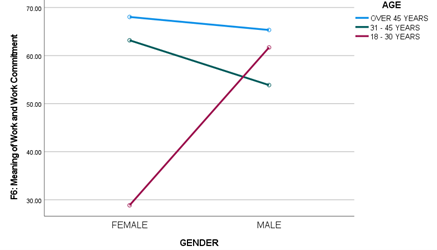
Higher levels of meaning of work were associated with higher age groups. Prime contractor workers over 45 years of age had the highest values and subcontract workers age 18-30 reported the lowest. Women had varied experiences depending on age with younger workers reporting less than half the level of meaning as their female colleagues 45 years and older. Women working for prime contractors also reported low levels of meaning compared to their male colleagues whose scores were among the highest.
Role Conflict
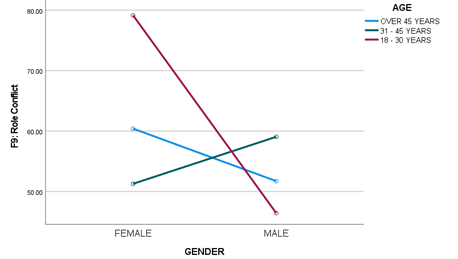
Workers experienced similar, moderate levels of role conflict except when it came to the younger age category. In that group, female workers reported the highest levels of role conflict, nearly 2x higher than males of the same age.
So What Does it Mean?
These findings offer a glimpse into the research and help to provide more context to the nature of psychosocial risks and how workers experience them differently. From a research standpoint, the results highlight the significance of demographic factors as predictors of experience while emphasizing the need for a more nuanced understanding of other factors that influence workers’ views. From a practical perspective, the information helps to shed light on some of the complexities of the worker experience and how demographic characteristics might be considered when designed interventions aimed at psychosocial risk management.
[1] McDonnell, M. D. (2024). Examining the Influence of Demographics on Workers’ Experiences of Psychosocial Risk in the Canadian Construction and Extractive Industries (Doctoral dissertation, Walden University).

No responses yet